What Are Buyer Intent Signals? The Plain English Guide for B2B
Buyer intent signals are public clues that tell you a company is about to buy something. This guide explains what they are, the 5 types that matter most, where to find them for free, and how to turn them into outreach that actually gets replies.
TL;DR
- A buyer intent signal is a public event that indicates a company has entered (or is approaching) a buying window
- There are 5 main types: growth signals, pain signals, trigger events, behavioural signals, and timing signals
- Most signals are completely free to monitor — job boards, funding databases, review platforms, ad libraries, and company websites are all public
- Intent signals are what separate 10–20% reply rate outreach from 1–4% spray-and-pray campaigns
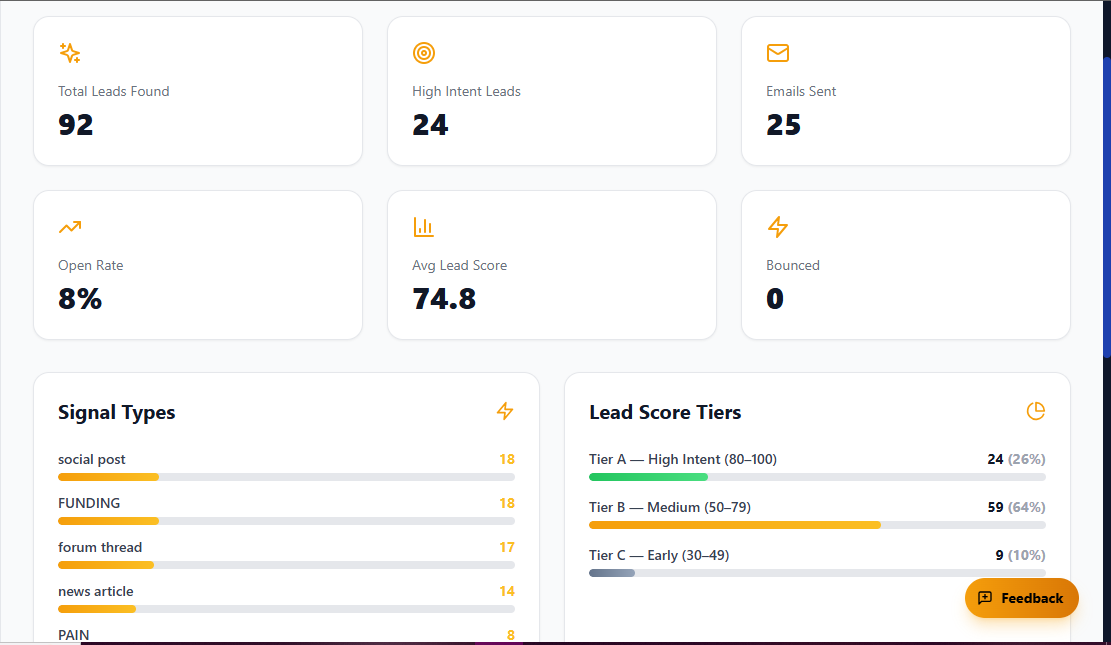
- Lytus C.O.R.E monitors all 5 signal types across 12 sources automatically, 24 hours a day
Here's a question most B2B sales advice never asks: How do you know when someone is ready to buy?
Not "would they theoretically benefit from your product" — but: is this specific company, right now, in a position where they're actively looking for a solution like yours?
The answer is buyer intent signals — and understanding them is the difference between cold outreach that lands and cold outreach that gets ignored.
What Is a Buyer Intent Signal?
A buyer intent signal is any observable, public event that suggests a company has entered (or is approaching) a buying window.
They're not secret. They're on job boards, press release sites, review platforms, ad libraries, and company websites — completely open to anyone paying attention. The problem isn't access. The problem is that manually monitoring dozens of sources for hundreds of companies every day is impossible without a system.
The 5 Types of Buyer Intent Signals
1. Growth Signals — "Money is Moving"
New job postings, headcount growth, increased ad spend, new product launches, office openings. When a company is scaling, budget is available and decisions are being made.
Where to find them: LinkedIn Jobs, company career pages, Meta Ad Library, Google Ads Transparency.
2. Pain Signals — "The Status Quo Is Breaking"
Dropping review scores on G2 or Trustpilot, public complaints on social media, outdated or broken websites, SEO ranking drops.
Why this works: A company in active pain has urgency. They're not evaluating solutions theoretically — they're looking for one now.
3. Trigger Events — "Change Creates Opportunity"
Funding announcements, leadership changes, mergers, regulatory shifts. Trigger events reset buying relationships and temporarily lower resistance to new vendors.
Where to find them: TechCrunch, press releases, LinkedIn company announcements.
4. Behavioural Signals — "Buying Curiosity Made Visible"
Job descriptions mentioning specific tools, public forum questions, tech stack changes visible via BuiltWith. When a company's JD mentions your competitor, they've already decided they need your category.
5. Timing Signals — "The Same Company at the Right Moment"
Budget cycles, contract renewal windows, fiscal year transitions, seasonal patterns. Timing is what turns a good prospect into the right prospect.
How to Use Intent Signals in Outreach
The most important rule: reference the signal in your first message. You're not pitching blindly — you're reaching out because something specific happened.
Example: Funding signal
Subject: Congrats on the raise — quick thought
Hi [Name], saw the Series A announcement — congrats. Companies at your stage typically start building outbound infrastructure right after a close. If you're evaluating tools for that, happy to show you how we've helped similar teams get pipeline moving in the first 60 days post-raise.
Signal-based outreach consistently hits 10–20% reply rates vs the 4–6% industry average — not because of better copy, but because you have a specific, time-sensitive reason to reach out that the prospect immediately understands.
This is exactly what Lytus C.O.R.E automates: monitoring all 5 signal types continuously, scoring them with AI, and delivering them as time-sensitive alerts matched to your ICP.
See buyer intent signals in your market
C.O.R.E monitors all 5 signal types across 12 public sources. 150 MVP spots. Closes April 10.
Apply for Early Access →